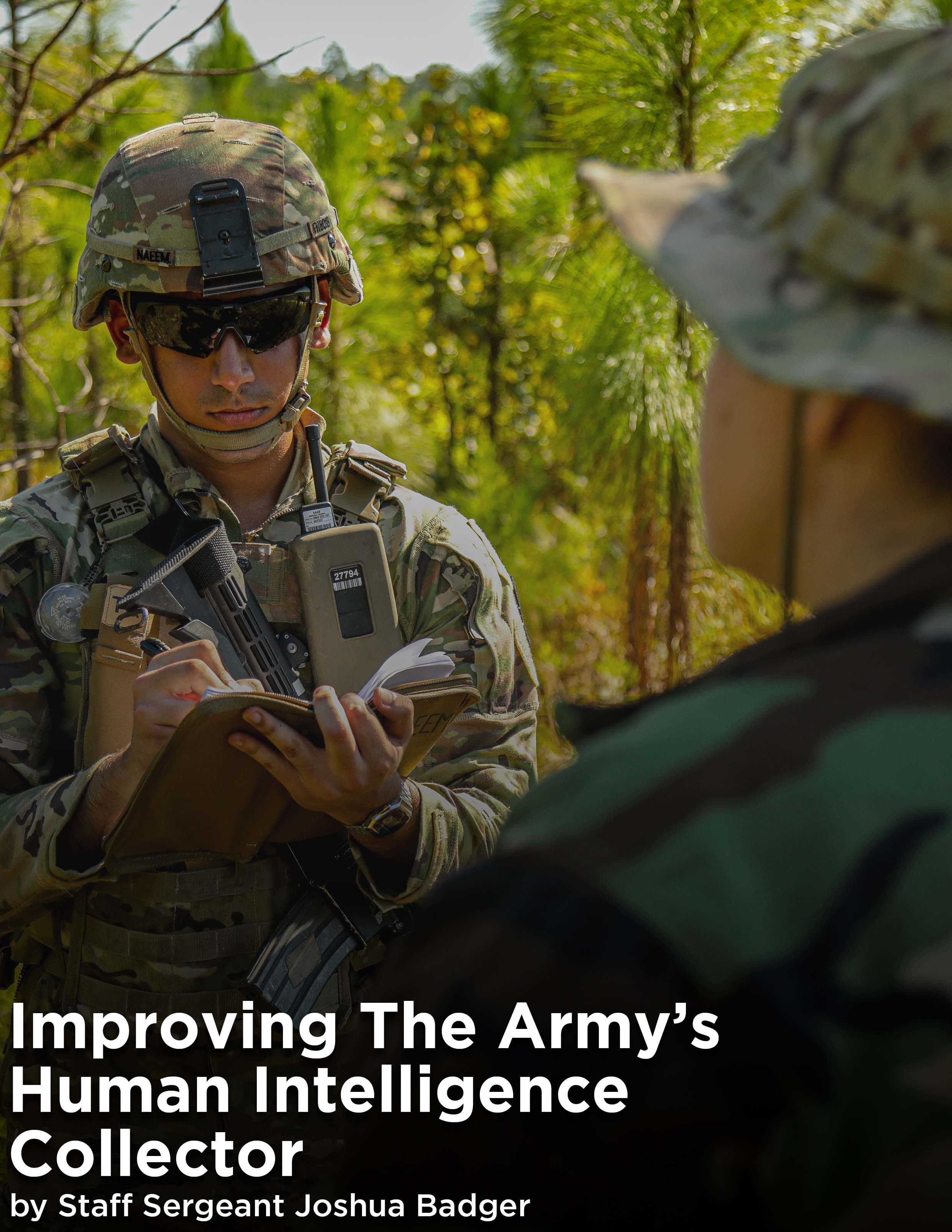
Improving The Army’s Human Intelligence Collector
Thoughts and opinions expressed in this article are those of the author. They do not reflect an official assessment of or the official policy or position of the U.S. Army Intelligence Center of Excellence or the Department of the Army.
Introduction
Over the past 15 years, the 35M military occupational specialty (MOS), Human Intelligence (HUMINT) Collector, has focused on three functions: intelligence interrogation, military source operations, now known as defense human activities, and debriefings. In 2024, a critical task site selection board updated the HUMINT collector critical task list to focus on interrogations and screenings, tasks most often associated with large-scale combat operations. This represents a significant shift from the HUMINT collector operations conducted over the past decade, and going forward, HUMINT collectors will primarily support the large-scale combat operations of maneuver commanders. To balance this shift in priorities, source operations will be severely curtailed for most HUMINT collectors. This presents an opportunity for 35M Soldiers to master the skills of interrogation and debriefing without the requirement to be top-level experts in a wide variety of other functions. This objective can be achieved by improving the assignment process, crafting new career development models, and reevaluating mission focus areas.
Opportunities and Challenges
The decision to refocus HUMINT collectors toward interrogation substantiates the need to specialize. This is most apparent within the U.S. Army Forces Command and the Army National Guard and Army Reserve, where over 80 percent of HUMINT collectors are assigned. Within the intelligence community and the Department of Defense, most top practitioners in this specialty dedicate themselves entirely to a singular focus, whether source handlers in the various government agencies, debriefers within the Defense Debriefing Service, or interrogators within the Joint Special Operations Command Intelligence Brigade and the High Value Detainee Interrogations Group.
Over the past 20 years, Army HUMINT collectors focused broadly on source operations, interrogations, and debriefings, leaving them less qualified and with less experience in any single area than their intelligence community and Department of Defense counterparts. However, with the focus now on large-scale combat operations, most Army HUMINT collectors can specialize in one area rather than be stretched amongst all the functions, thus becoming truly valuable assets to the Army and the greater intelligence community.
Retention among initial and mid-term HUMINT collectors historically has presented a challenge for the Army. Though the rate fluctuates, it is typically under 30 percent, and most HUMINT collectors cite the lack of opportunities to perform their assigned jobs as their primary reason for leaving Army service. Because it costs the Army over $150,000 to train a HUMINT collector that attends the Defense Language Institute, this disappointing retention rate represents a considerable investment loss. Making better use of trained HUMINT collectors and providing them with operational opportunities in their first assignment can address this significant concern and improve the retention rate.
A Way Forward
The following paragraphs contain recommendations for strengthening the HUMINT collector MOS, resulting in an Army HUMINT workforce that will better support the maneuver commander.
Duty Assignments. Refining the 35M MOS must begin with Advanced Individual Training (AIT). Course performance must be tied to a Soldier’s potential first duty station to provide meaningful opportunities for practice and refinement of their specialty; this will require coordination with Human Resources Command and the Office of the Chief of Military Intelligence. Soldiers exhibiting higher-level potential should be assigned to units likely to have an active HUMINT collection mission, such as a Special Forces Group support battalion, U.S. Army Intelligence and Security Command, or a combatant command. The halted Quickstart program, which identified top performers during AIT and selected them for special follow-on assignments, could be reinstated to support this goal. A class order of merit list could be the basis for selection. A similar concept currently in use is the Advanced HUMINT Management Bridge, which typically provides Soldiers attending the MOS reclassification course follow-on opportunities through deployment or additional training. Sending high-performing 35M graduates to the Defense Strategic Debriefing Course is another option. This will further sharpen the foundational skills they acquired at AIT and certify them with the N7 (Strategic Debriefer) additional skill identifier, enabling them to conduct debriefing operations in specific areas of responsibility. Implementing any of these during 35M AIT would yield tremendous results for the force.
Force Reduction. Given continuing budgetary constraints, implementing these proposed solutions requires reducing the number of HUMINT collectors. Army structure changes address this issue but have the potential to further refine the 35M force structure through additional downsizing. An assumption under this model is that every 35M would become more valuable because the loss of manpower would be balanced against the increased skills they bring to the fight. If there are fewer HUMINT collectors, they must be better prepared.
Foreign Language Training. The current HUMINT collector language training model does not meet standards to operate effectively in large-scale combat operations. A complete discussion of those standards is beyond the scope of this article; for this discussion, we will note simply that the Army must revisit the requirement that HUMINT collectors must achieve, at minimum, Level 2 (advanced proficiency) in reading and listening and Level 1+ (high intermediate) in speaking on the Defense Language Proficiency Test. In addition, there will not be enough civilian interpreters to meet mission requirements in a large-scale combat environment.
Reading. The reading standard should be lowered or eliminated. This is especially relevant to document and media exploitation (DOMEX), which refers to the process of translating enemy documents. Historically, this has been a time- and resource-intensive process: if there was not a translator on site proficient enough in the target language to translate enemy documents, physical or digital copies had to be sent to the rear to be translated by linguists. Technological advances have made DOMEX a task that can be performed instantly by virtually any Soldier using a handheld electronic translator. Most Soldiers now use encrypted devices in place of hard-copy documents, which eliminates much of the need for on-the-spot DOMEX. Reducing or eliminating the reading requirements would allow HUMINT collectors more opportunities to master their speaking skills.
Speaking. The real value of the 35M lies in their speaking proficiency, and the current standard of Level 1+ (high intermediate proficiency) is simply insufficient to conduct operations in the target language at a valuable level. A Level 2+ (advanced-plus proficiency) and/or a successful Two-Score Oral Proficiency Interview (TSOPI) should be the minimum acceptable standard for the HUMINT collector. At that level, the practitioner will possess the skills necessary both to speak and to listen effectively while conducting operations.
Listening. The current listening standard of Level 2 (advanced proficiency) for the HUMINT collector is arguably irrelevant, as it is more applicable to linguists in the 35P (Signals Intelligence Voice Interceptor) MOS, who don’t speak conversationally with detainees, but instead listen passively with no speaking required—an entirely different skill set than the listening employed while conversing. The listening requirement for HUMINT collectors is adequately met through TSOPI, which assesses both speaking and listening skills.
One day, technology will likely overtake the need for specialized foreign language training—but until then, trained HUMINT collectors are the solution. Downgrading the reading and listening requirements to the 0+ level (or eliminating them) while upgrading the speaking proficiency requirement to a Level 2+ (and/or implementing the TSOPI as Army Special Operations Forces currently use it) will result in more capable collectors.
Career Development. The 35M MOS offers Soldiers numerous opportunities to attend advanced courses that develop the practitioner into a more well-rounded collector. Within the career field, the focus should be on a progressive journeyman-to-master model. To produce a 35M force capable of leading HUMINT operations, U.S. Army Forces Command’s annual training guidance should include the following requirements:
- Defense Strategic Debriefing Course. HUMINT collectors practice skills and gain experience in debriefing. HUMINT collection teams (HCTs) should have a minimum of one course-trained and certified debriefer.
- Advanced Operations Course-HUMINT. Equips HUMINT leaders with skills to plan, integrate, and manage operations supporting commanders’ decision making. This course teaches members of the HUMINT community how to lead and perform at the junior noncommissioned officer level in a deployed environment.
- Joint Counterintelligence and HUMINT Analysis and Targeting Course. Teaches how to leverage analytical processes to support targeting at the tactical, operational, and strategic levels. This course, along with the Advanced Operations Course, is ideal for HUMINT collectors at senior specialist or sergeant levels.
- Joint Senior Interrogator Course. A “train-the-trainer” course that increases the operational effectiveness of interrogation capabilities and enables students to transfer knowledge to their home station. The target audience is HUMINT collectors at the staff sergeant level. Every HCT should include at least one graduate to oversee interrogation operations.
Each of these courses enhances the versatility of Army HUMINT collectors and increases the ability of HCTs’ to support maneuver commanders in developing a comprehensive picture of the operational environment.
Conclusion
The 35M MOS is at a crossroads. Recent updates from the critical task site selection board have created a unique opportunity for the MOS to shift from a generalist model to one of specialization and focused excellence. By utilizing technological advances, HUMINT collectors can become a force multiplier to consequential missions across the Army intelligence enterprise. Implementing the outlined recommendations, in addition to addressing retention concerns, will result in more common and effective use of HUMINT collectors. Better trained, more focused HUMINT collectors offer commanders greater flexibility in operations with fewer resources. By refining assignment processes, career development models, and mission focus, the Army can create a sustainable and competent force of HUMINT professionals who, in turn, become masters in their field and significantly contribute to HUMINT operations within the intelligence community and the Department of Defense.
SSG Joshua Badger currently serves in the S-3 of the Headquarters and Headquarters Company, U.S. Army Intelligence Center of Excellence, Ft. Huachuca, AZ. His previous assignments include service with the 504th Expeditionary Military Intelligence Brigade, Special Operations Command Central, and U.S. Army Special Operations Command. SSG Badger has deployed to Afghanistan and Qatar, conducting tactical human intelligence (HUMINT) operations, organizational level debriefings, and serving as the Theater Special Operations Command J-2X Forward noncommissioned officer in charge. SSG Badger has also completed multiple HUMINT Training-Joint Center of Excellence courses.