MI Is Out Front in Army Transformation
Photo Couresy of SPC Timothy J. Belt.
Editor’s Note: In continuation of the historical retrospective that began with our 50th Anniversary Commemorative Compilation, every quarter, the Military Intelligence Professional Bulletin will highlight an article from the past that is still relevant today. This article first appeared in the October–December 2000 issue.
This special issue of the Military Intelligence Professional Bulletin (MIPB) focuses on transformation. The Chief of Staff of the Army identified transformation as a crucial aspect of his vision. This Army transformation by design will make the Army a full spectrum, strategically relevant force. The Military Intelligence Corps plays a key role in Army Transformation. The basis for many of the initiatives that will move the Army to the objective force is an assumption of improved situational awareness, which includes an accurate and timely understanding of opponents, neutrals, weather, and terrain. Achievement of this increased level of situational awareness rests, in large measure, on our ability to deliver refined intelligence products across the force. This is an exciting time to be intelligence professionals and promises to move our Corps into an even closer membership in the combined arms team.
We often think of transformation as focusing on equipment. Although equipment is important, it is the human dimension—our soldiers and civilians—that will transform the Army. Transformation is a new way of doing our business, not simply a “tweaking” of our Cold War organizations, but rather a fundamental examination of what the MI Corps must accomplish as part of the combined arms team. In this issue of MIPB, we will discuss many aspects of transformation, but I would first like to set the stage.
Enabling and Integrated Intelligence
The MI Corps has primarily focused on providing “enabling” intelligence, which dealt mainly with the disposition and intention of opponent formations. This intelligence is essential for conducting the military decisionmaking process and critical to a commander disposing and committing his formations. It is primarily a planning-focused activity. Once direct combat operation began within the “Red zone,” there was little direct intelligence contribution. Weapons system capabilities often provided the basis for mission effectiveness and stand off.
With changes in the operational environment, especially the proliferation of sophisticated weapons systems and the requirement to deploy forces quickly over long distances, we must change the mission effectiveness equation. Intelligence, surveillance, and reconnaissance (ISR) must become part of the overmatch ratio. ISR together with mobility, lethality, and survivability must be what guarantees overmatch during the close fight on the 21st century battlefield. In addition to “enabling” intelligence, we must provide “integrated” intelligence—that intelligence which is closely linked to the tactical operator engaged in the “Red zone” fight. These intelligence capabilities must be a part of the ongoing combat operation, not just support planning of the operation. Some examples of this approach are—
- Integrated human intelligence (HUMINT) soldiers in the Reconnaissance, Surveillance, and Target Acquisition (RSTA) Squadrons of the Initial Brigade Combat Teams (IBCTs).
- Provision of enemy situational awareness information directly to combat platforms by the Force XXI Battle Command Brigade and Below (FBCB2) system.
- Integration of unmanned aerial vehicles (UAVs) with manned Army Aviation helicopters.
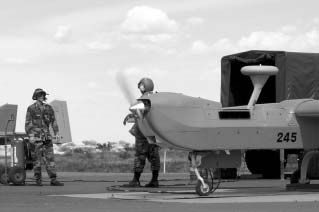
Photo Couresy of SPC Timothy J. Belt.
Force Structure
The force structure of the MI Corps must support our mission. We need increased analysis, HUMINT, and imagery capabilities within our tactical organization. Additionally, we need to improve our ability to focus and integrate the myriad ISR capabilities available to a commander. These assets include a wide range of capabilities operated across the battlefield by both MI organizations and other battlefield functional areas such as Army Aviation, Special Operations Forces, Field Artillery, Chemical Corps, Engineers, and many others. This integration role has long been the function of the intelligence officer but in many cases, neither the personnel nor the equipment were available to accomplish the mission. The varied nature of the future battlefield makes this integration mandatory.
The Reserve Component’s MI force structure—for the U.S. Army Reserve (USAR) and the U.S. Army National Guard (ARNG)—must also transform. Crucial initiatives include the organization of additional, fully capable, divisional MI battalions in the ARNG and more effective support organizations in the USAR. The superb performance of ARNG and USAR soldiers in recent operations and contingencies underscores both the value of these professionals and the importance of proper structure and integration.
U.S. Army photo.
Equipment and Personnel
There is an equipment aspect to transformation. First, our equipment must get to the fight. All equipment must be C-130-transportable. We must integrate functions of various pieces of equipment to reduce tactical operations center (TOC) footprint and deployability issues. MI must develop and field sensors specifically aimed at the urban environment. Our automation systems—the All-Source Analysis System (ASAS) and the Army Battle Command System (ABCS)—must be able to share a common picture with all echelons and the joint and national intelligence community. They must also provide tools across the operational spectrum from stability and support operations, through small-scale contingencies, to high-intensity operations.
The key to successful transformation remains our soldiers and civilians. We must continue to develop their basic intelligence skills of analysis, collection, and integration. None of these initiatives in any way reduces the requirement for first-class individual intelligence skills capable of operating in the digital environment of the information age. Our military occupational specialty (MOS) structure needs critical examination to ensure it provides the commander with the expertise and flexibility to operate in the 21st century and also assures rewarding career opportunities for our soldiers. Strong leadership by our officers, noncommissioned officers, and civilians will be required during this period of unprecedented change.
Conclusion
Our organizations, equipment, doctrine, and training will change, but the result will be the provision of improved intelligence as part of the combined-arms team. It is important that we all understand the mission and environment of today’s Army and move out to continue our tradition as the best intelligence service in the world.
ALWAYS OUT FRONT!
Major General John D. Thomas, Jr., enlisted in the U.S. Army in 1968. He received his commission following graduation as a Distinguished Graduate from the Field Artillery Officer Candidate School and his initial positions were in the 7th and 2d Infantry Divisions and command of an AIT (advanced individual training) company. His past intelligence and electronic warfare assignments included Field Station Augsburg; the Combined Forces Command and U.S. Forces–Korea; the Department of the Army Staff; Deputy Chief for Intelligence, Special Technical Operations Division, J3, Joint Staff; and Associate Deputy Director for Operations (Military Support) at the National Security Agency (NSA) and Deputy Chief, Central Security Service (CSS). MG Thomas has served in many command positions including C Company (Guardrail), 15th MI Battalion (Aerial Exploitation (AE)), 504th MI Brigade; 3d MI Battalion (AE), 501st MI Brigade; 11th MI Brigade (Training); U.S. Army Intelligence and Security Command (INSCOM); and the U.S. Army Intelligence Center and Fort Huachuca. He became the fifth Chief of the MI Corps in June 1998. He is a graduate of the Armed Forces Staff College and the National War College . MG Thomas is a Master Army Aviator rated in both fixed-wing and rotary aircraft and is a fixed-wing instructor pilot. He earned a Bachelor of Arts degree in History from Wilkes College in Wilkes-Barre, Pennsylvania, and a Master of Arts degree in International Relations from the University of Southern California.